
⚡ Circuit Breaker (MCB/MCCB) Selection Guide for Beginners
Choosing the right Miniature Circuit Breaker (MCB) or Moulded Case Circuit Breaker (MCCB) is essential for protecting home and industrial electrical systems. Selecting the wrong breaker can cause nuisance tripping or even fail to protect against short circuits and overloads.
This guide explains the fundamentals of selecting circuit breakers based on ampere rating, trip curve, fault level, and includes simple real-world examples.
Table of Contents
🔌 What Is a Circuit Breaker?
A circuit breaker is an automatic electrical switch that protects a circuit from:
- Overload (excess current)
- Short circuit (fault current)
- Earth faults (in some MCCBs/RCCBs)
Two main types:
✔ MCB – Miniature Circuit Breaker
Used for home and light commercial applications (up to 100A).
✔ MCCB – Moulded Case Circuit Breaker
Used for industrial loads, high currents (100A–1600A+), adjustable settings, higher breaking capacity.
Step 1 — Calculate Load Current
Use the simple formula: I=PVI = \frac{P}{V}I=VP
Example:
Load = 2300 W I=2300230=10AI = \frac{2300}{230} = 10AI=2302300=10A
Breaker should have a rating 20–30% higher than the load to avoid nuisance tripping.
✔ Suggested MCB: 16A
Step 2 — Select the Trip Curve (B, C, D Types)
Trip curves define how the breaker reacts to sudden surges.
MCB Trip Curve Types
| Curve | Trips At | Best For |
|---|---|---|
| B-Curve | 3–5 × In | Homes, lights, sockets |
| C-Curve | 5–10 × In | Motors, ACs, small pumps |
| D-Curve | 10–20 × In | Heavy motors, welding, transformers |
Rule:
- Home wiring → B Curve
- Motors/inductive loads → C Curve
- Heavy machinery → D Curve
Step 3 — Check Short-Circuit Breaking Capacity (kA Rating)
Breaking capacity = the maximum current the breaker can safely interrupt.
Common MCB kA ratings:
- 6 kA → houses
- 10 kA → commercial/industrial
- 15–50 kA (MCCB) → industries, factories
✔ For homes:
MCB with 6 kA is usually sufficient.
✔ For workshops/factories:
Short circuit level is high → use 10 kA or higher.
Step 4 — Select MCCB Settings (Industrial)
MCCBs have adjustable protections:
✔ Overload Setting (Ir)
Set to 1.05–1.2× full load current
✔ Short-Circuit Instantaneous Setting (Ii)
Set based on equipment type:
- Motors: 6–10 × FLC
- Transformers: 10–14 × FLC
- General feeders: 5–8 × FLC
Example:
Motor FLC = 32A
Use MCCB of 40A with:
- Ir = 32–38A
- Ii = 200–320A
Step 5 — Cable Size Matching
Circuit breaker must always protect the cable.
Example:
If cable is 2.5 mm² (current rating 18–24A),
Choose:
✔ 16A MCB → Safe
✘ 32A MCB → Unsafe (cable will burn before breaker trips)
Rule:
Breaker rating ≤ Cable current rating
🧮 7. Examples of Correct Circuit Breaker Selection
Example 1: Lighting Circuit (Home)
Load = 500 W
Current = 2.17 A
Correct breaker:
- 6A MCB
- B Curve
- 6 kA
Example 2: 13A Socket Circuit
Load = 2500 W
Current = 10.86 A
Breaker:
- 16A MCB
- C Curve (if heavy appliances)
- 6 kA
Example 3: Air Conditioner (1.5 Ton)
FLC ≈ 8A
Starting current ≈ 5× FLC
Breaker should be:
- C Curve 16A MCB
- 6 kA
Example 4: Industrial Motor (5 kW, 3-Phase)
Current (approx) = 10A × multiplier
Breaker:
- 32A MCCB
- C or D Curve
- Breaking capacity: 25–35 kA
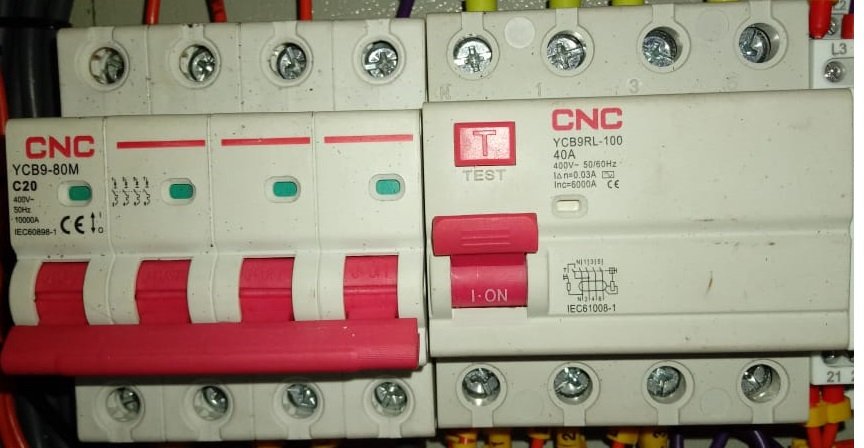
🧯 8. When to Use RCCB or RCBO?These protect against electric shock and earth leakage.
✔ RCCB
- No overload protection
- Detects leakage only
✔ RCBO
- MCB + RCCB combined
- Best for high-safety locations
Use RCBO for:
- Bathrooms
- Wet areas
- Outdoor sockets
- Kitchen circuits
🛠 9. Final Selection Checklist
Before choosing a breaker, check:
✔ Load current
✔ Trip curve type
✔ Cable size
✔ Short-circuit capacity (kA)
✔ Application type (home/industrial)
✔ Safety requirements (RCCB/RCBO)
🏁 Conclusion
Selecting the correct MCB or MCCB ensures safe and reliable protection from overloads, short circuits, and electrical fires.
By following these steps—
- Calculate load
- Choose the correct curve
- Select an adequate kA rating
- Ensure cable protection
- Use RCCB/RCBO where needed
—You can confidently choose the right breaker for any installation.