
Imagine opening your electricity bill and feeling shocked. Your energy usage looks normal, but the total cost is much higher than expected. In many cases, the hidden reason is a poor electrical power factor. This happens in factories, offices, hospitals, and even renewable energy plants around the world.
Power factor is a global issue because electrical utilities must supply not only useful power, but also extra current caused by poor system behavior.When PF is low, equipment works harder, cables heat up, and utilities apply penalties.
That is why engineers, technicians, and managers all need to understand it.
This guide is written for students, practicing engineers, technicians, and decision-makers.
By the end of this article, you will clearly understand what PF is, why it becomes low, how to calculate it, and how to improve it safely in real systems.
What Is Power Factor?
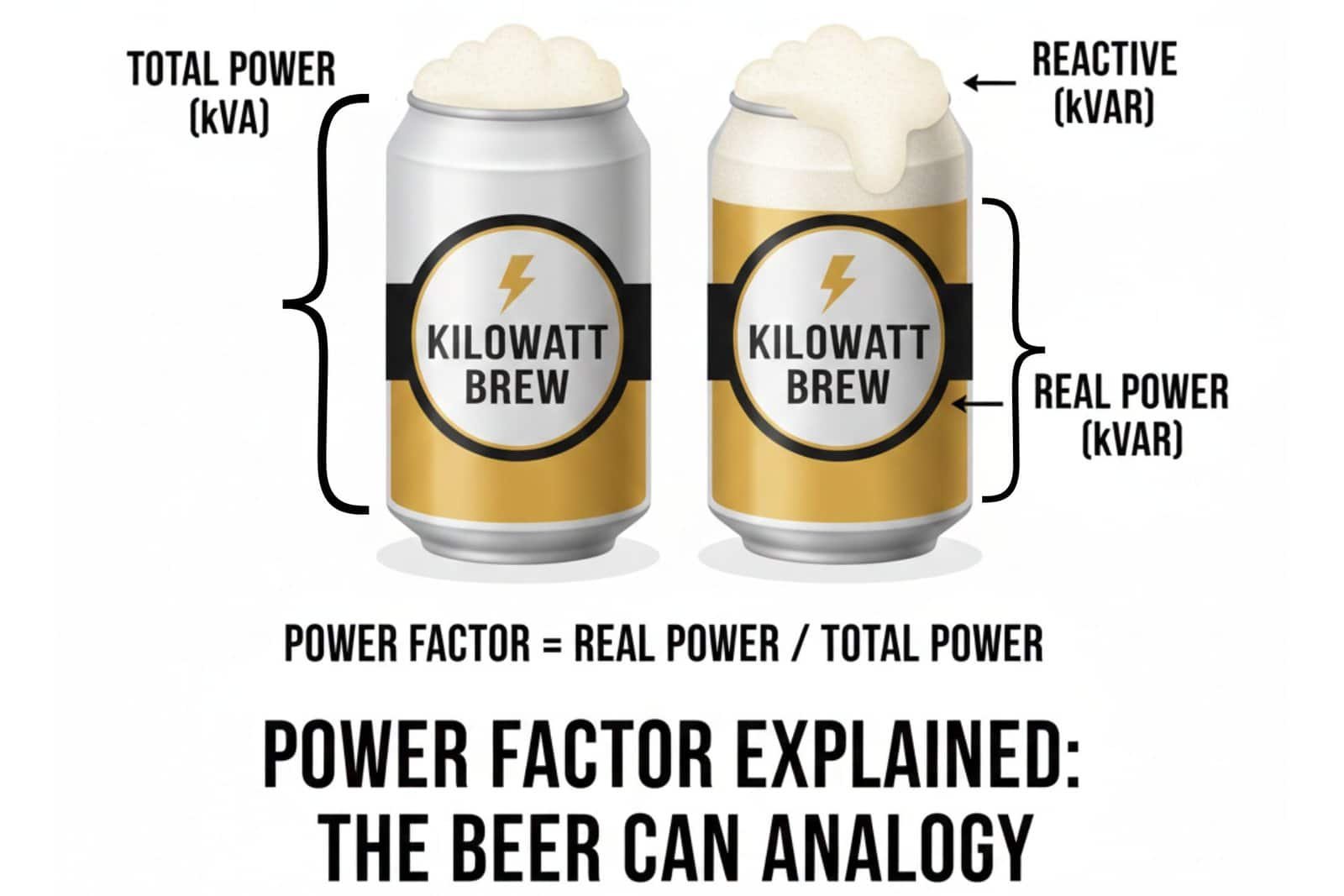
PF(Power factor) tells us how effectively electrical power is being used.In simple words, it shows how much of the supplied power is actually doing useful work.If most of the power is useful, the power factor is high.If much of it is wasted as reactive power, the power factor is low.
There are two important types of power involved.
Active power, measured in kilowatts (kW), does the real work like running motors or lighting lamps. Apparent power, measured in kilovolt-amperes (kVA), is what the utility must supply to the system. Power factor is the ratio of these two values.
✔ Formula
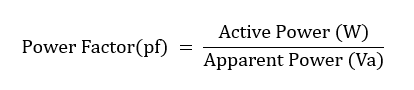
Where:
- W = useful (real) power
- VA = total supplied power
- φ (phi) = angle between voltage & current
✔ Types of Power Factor
- Lagging PF → It happens when the current lags behind the voltage. This is mainly caused by inductive loads like motors, transformers, and reactors. Most industries operate witha lagging power factor because motors are everywhere.
- Leading PF → Leading power factor occurs when current leads voltage. This usually happens when too many capacitors are connected to the system. While capacitors are useful, excess capacitance can cause over-correction.Leading power factor can create a voltage rise and damage sensitive equipment.
- Unity PF (1.0) →Unity power factor means the power factor is exactly one. In this case, all supplied power is used effectively. This is the ideal condition that engineers aim for. In practice, it is difficult to maintain because loads change throughout the day.
✔ Real-Life Example:
If your factory has:
- Load = 100 kW
- PF = 0.7
Then apparent power = S=P(Load)/PF
S = 100/0.7 = 142.8 kVA
You must pay for 142.8 kVA even though you only use 100 kW!
This is why improving PF is important.
Causes of Low PF
The main reason for low power factor is inductive equipment. Induction motors draw reactive power to create magnetic fields. Transformers operating at light load also reduce PF. Welding machines and discharge lighting add further reactive demand.
✔ Common Causes:
- Induction motors
- Transformers operating at light load
- Welding machines
- Fluorescent lamps & CFLs
- Air compressors
- HVAC systems
✔ Why Inductive Loads Reduce PF?
Inductors create a magnetizing current that does not do real work. This increases kVA, but not kW, leading to a low power factor.
Effects of Low PF
Because of low PF we have to face many difficulties. A low PF can cause:
- Higher electricity bills – Utility companies charge penalties for low PF.
- Increased system losses – More current flows → more copper loss (I²R).
- Overloaded transformers & cables – Low PF increases current, reducing the capacity of equipment.
- Poor voltage regulation – Voltage drops become significant in long cables.
- Reduced overall system efficiency
How to Improve PF
This is the process of improving PF to an acceptable level. This is done by supplying reactive power locally instead of drawing it from the grid. Capacitors are commonly used because they provide reactive power efficiently. They counteract the effect of inductive loads.
✔ Methods for PF improvement:
- Capacitor banks
- Automatic Power Factor Correction (APFC) panels
- Synchronous condensers
- Phase advancers
- Using energy-efficient motors
Best Practices to Maintain a Healthy PF
Power factor should be monitored regularly using reliable meters. Loads should be balanced properly across phases. Capacitor banks require periodic inspection and maintenance. Upgrading outdated equipment also improves long-term performance.
Conclusion
Electrical PF is not just a classroom concept. It directly affects cost, efficiency, and reliability in real systems. Understanding it allows engineers to design smarter and operate better. When managed correctly, PF becomes an advantage rather than a problem.
✔ Reduce electricity bills
✔ Increase equipment lifespan
✔ Improve voltage levels
✔ Enhance overall system performance
Power Factor Correction is not just a cost-saving measure—it’s an essential part of good electrical system design.