Electricity is something we use every day, but most people don’t really understand how it works. We switch on lights, charge our phones, and run machines without thinking about the type of current behind them. When people hear the terms AC and DC, they often remember short definitions but still feel confused. This confusion becomes bigger during exams, interviews, or real engineering work. In this article, I’ll explain the difference between AC and DC in a simple, real-life way that actually makes sense.
What Is Electric Current? A Simple Starting Point
Electric current is the flow of electric charge through a conductor like a wire. You can think of it as water flowing through a pipe. If the water flows smoothly in one direction, it behaves differently than water that keeps changing direction. In electricity, this direction of flow is very important. That is where AC and DC come into the picture.
What Is AC (Alternating Current)?
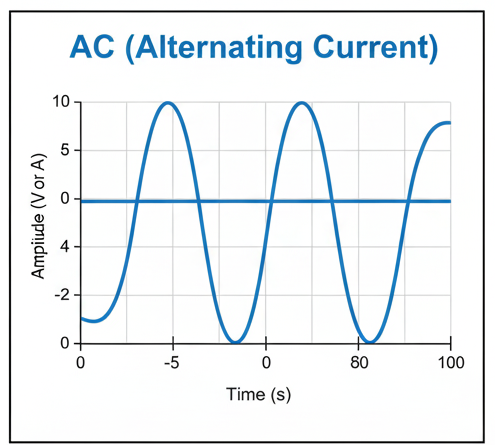
AC stands for Alternating Current. In AC, the direction of current keeps changing back and forth. This change happens many times every second. For example, in many countries, AC changes direction 50 or 60 times per second.
The electricity that comes to your home is AC. Power plants generate AC because it is easy to change its voltage level. This makes AC very efficient for sending electricity over long distances. That is why national power grids use AC instead of DC.
Real-Life Examples of AC
When you turn on a fan, television, or refrigerator at home, you are using AC power. Large factory machines and motors also run on AC. Street lights and office buildings depend on AC supply from the grid. Simply put, anything that plugs directly into a wall socket uses AC.
Why AC Is Used for Power Distribution
AC is used mainly because its voltage can be increased or decreased easily using transformers. High voltage means low current, and low current means less energy loss in transmission lines. This saves money and energy on a large scale. That is why power plants send electricity at very high voltages and then reduce it before it reaches homes. This system would be very difficult with DC.
What Is DC (Direct Current)?
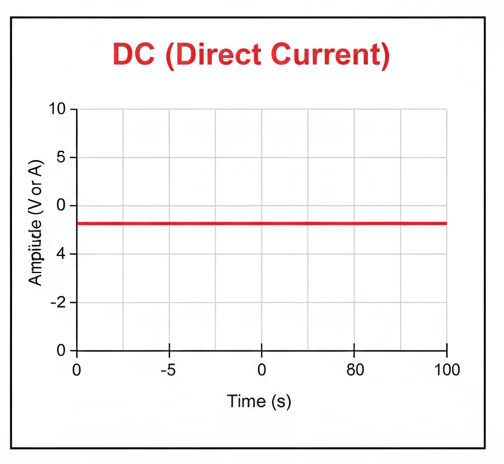
DC stands for Direct Current. In DC, the current flows in only one direction. The voltage remains constant and does not change direction. This makes DC very stable and predictable.
DC is commonly used in electronic devices. Most small gadgets need a steady voltage to work properly. Because of this, DC is ideal for electronics.
Real-Life Examples of DC
Batteries are the best example of DC power. Your phone, laptop, remote control, and flashlight all run on DC. Solar panels also produce DC electricity. Even electric vehicles store energy in DC form inside their batteries.
Why Electronics Prefer DC
Electronic components like transistors and integrated circuits need a stable voltage. If the voltage keeps changing direction, these components may not work correctly. DC provides smooth and controlled power, which protects sensitive parts. That is why almost all electronic circuits use DC internally. Even devices that plug into AC sockets convert AC into DC first.
Key Differences Between AC and DC
The main difference between AC and DC is the direction of current flow. AC changes direction, while DC flows in one direction. AC voltage keeps rising and falling, but DC voltage stays steady. AC is best for power transmission, while DC is best for electronics and storage. Both types are important, and neither can fully replace the other.
AC vs DC Comparison Table (Simple View)
AC changes direction and is used in homes and industries.
DC flows in one direction and is used in batteries and electronics.
AC is easy to transform and transmit over long distances.
DC is easy to store and control in small systems.
Why Do We Convert AC to DC in Daily Life?
If your home uses AC, you might wonder why your phone charger exists. The reason is simple. Your phone cannot work directly on AC power. Inside the charger, AC is converted into DC using electronic circuits.
This converted DC power is safe and suitable for charging batteries. Without this conversion, electronic devices would get damaged. That small charger is doing an important engineering job.
AC and DC in Modern Technology
In solar power systems, solar panels produce DC electricity. This DC power is converted into AC using an inverter so it can be used in homes. In electric vehicles, energy is stored as DC in batteries, but motors often run on AC. UPS systems also use both AC and DC to provide backup power. Modern technology depends on a smart combination of both types.
Common Misunderstandings About AC and DC
Many people think AC is always dangerous and DC is always safe. In reality, both can be dangerous depending on voltage and current levels. Another myth is that DC cannot be sent over long distances. With modern technology like HVDC, DC transmission is now possible. AC is not outdated, and DC is not new; both are evolving together.
How to Remember the Difference Easily
A simple way to remember is this. Wall sockets mean AC, and batteries mean DC. If electricity travels far, it is usually AC. If electricity is stored or used inside electronics, it is DC. This method helps in exams and real-life understanding.
Which Is Better: AC or DC?
This question does not have a single answer. AC is better for power generation and distribution. DC is better for electronics and storage. Engineers do not choose one blindly; they choose what fits the application. In real systems, AC and DC work together.
Final Thoughts
AC and DC are not competitors; they are partners in modern electrical systems. Understanding their differences helps you understand how the world around you works. Once you connect theory with real devices, electricity becomes much easier to grasp. As an electrical engineer, I always believe learning should feel practical, not confusing. If this explanation helped you, you are already thinking like an engineer.