

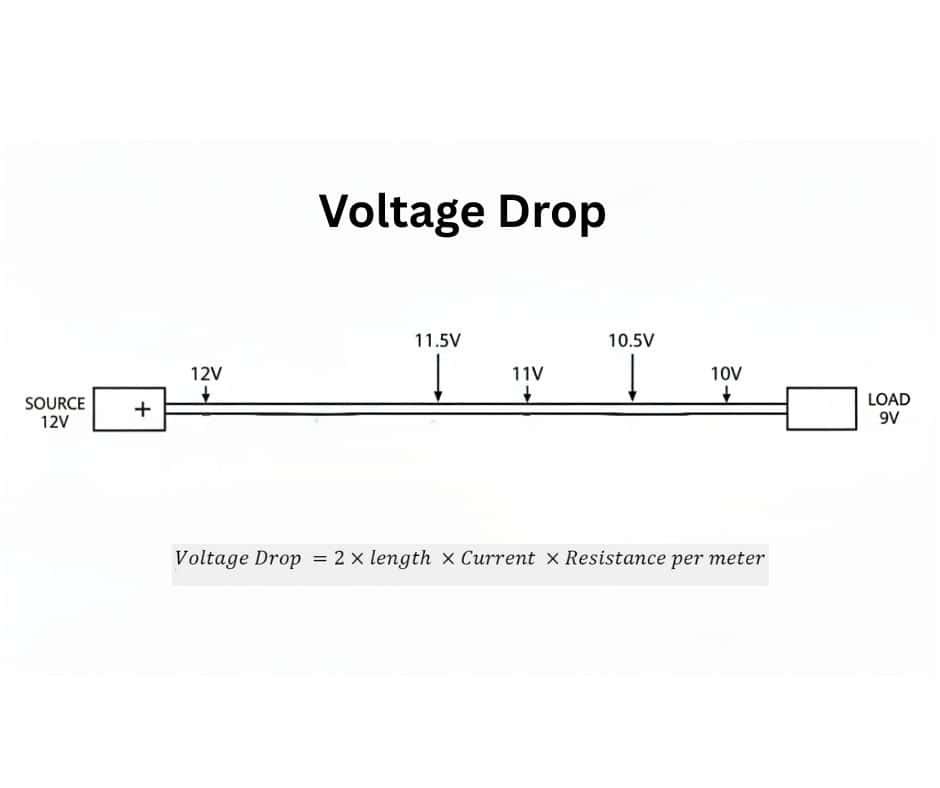
Voltage drop is an essential concept in electrical design. When current flows through a conductor, some voltage is lost due to its resistance. Too much voltage drop can cause equipment malfunction, motor overheating, and poor lighting performance.
This guide provides a simple method to choose the correct cable size, and use ready-made tables for both household and industrial circuits.
What Is Voltage Drop?
Voltage drop is the decrease in voltage as electricity flows through a wire, caused by resistance and length of the conductor.
Formula:
Voltage Drop = 2 x Length x Current x Resistance per meter
The number 2 is used because current travels to the load and comes back through the neutral. The length is the one-way distance from the distribution board to the load. Cable resistance depends on the cable size and material.
But for practical electrical design, we use an extended formula.
Standard Formula
For Single Phase VDrop = 2 × Length × Current × Resistance per meter
For Three Phase VDrop = 1.732 × Length × Current × Resistance per meter
Where:
- I = Load current (A)
- L = Cable length (m)
- R = Cable resistance per km (Ω/km)
- Divide by 1000 to convert meters to km
Percentage Voltage Drop:
Percentage voltage drop helps us understand how serious the drop is. It compares the voltage lost to the supply voltage. This makes it easier to check against standard limits.
Percentage Drop = (VDrop ÷ Supply Voltage) × 100
Standard allowed levels:
- House wiring: ≤ 3% lighting, 5% sockets
- Industrial wiring: ≤ 5% total
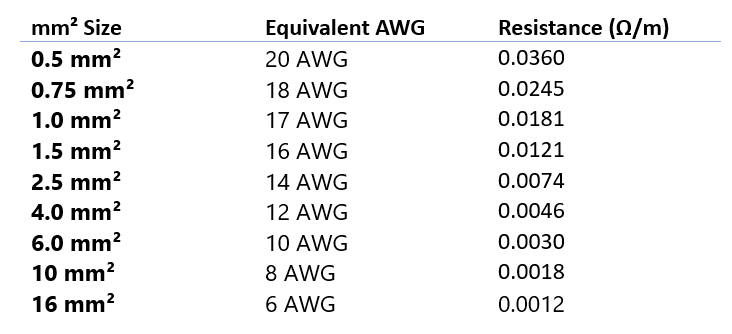
Cable Resistance Chart (Common Cable Sizes)
Below is a simplified chart using copper cables at 230V single-phase.
Cable Resistance Values (Cu)
Cable Size Selection
Cable size is not chosen only by current rating. Even if a cable can carry the current safely, voltage drop may still be too high. This is common in long cable runs.
The usual approach is to assume a cable size first. Then calculate voltage drop using that size. If the value is within the allowed limit, the cable is acceptable
To select cable size:
- Identify load current
- Measure total cable length
- Calculate voltage drop
- Compare with the allowed limit
- Increase cable size if drop is too high
- If you are unsure how the cable size was chosen in this example, you can first read this simple cable size selection guide and then return here – How to Choose the Right Cable Size for House Wiring With Simple Calculations
Examples
Example 1: House Wiring (Lighting Load)
Given:
- Load = 500 W
- Voltage = 230 V
- Current (I) = 500/230 = 2.17 A
- Cable size = 1.5 mm² (R = 12.1 Ω/km)
- Length = 20 m (one way)
I=Voltage/Power=230V/500W=2.17 A
Find Cable Resistance =0.0121 Ω/m
Calculate Total Loop Resistancev- For single-phase, current flows out and back
Total Length=2×20=40 m
Rtotal=0.0121×40=0.484 Ω
Calculate Voltage Drop
Vdrop=Current×Total Resistance =2.17×0.484=1.05 V
Calculate Percentage Drop = Voltage Drop=(1.05/230)×100=0.46%
✔ Result:
Voltage drop is within limits → 1.5 mm² cable is acceptable.
Example 2: House Wiring (Socket Load)
Given:
- Load = 3000 W
- Current = 3000/230 = 13 A
- Cable = 2.5 mm² (R = 7.41 Ω/km)
- Length = 25 m
Calculate CurrentI=3000 W230 V=13.04 A(round to 13 A)I=230 V3000 W=13.04 A(round to 13 A)
Cable Resistance -0.00741 Ω/m
Calculate Total Loop Resistance
For single-phase wiring, remember the go and return
Total Circuit Length=2×25 m=50 m
Rtotal=0.00741×50=0.3705 Ω
Calculate Voltage Drop
Vdrop=Current ×Total Resistance=13×0.3705=4.82 V
Calculate Percentage Drop = (4.82/230)*100% = 2.1%
✔ Result:
Cable size OK for sockets (limit 5%).
Example 3: Industrial Three-Phase Motor
Given:
- Motor load = 15 kW
- Voltage = 400V
- Current ≈ 28 A
- Cable = 6 mm² (R = 3.08 Ω/km)
- Length = 60 m
Calculation
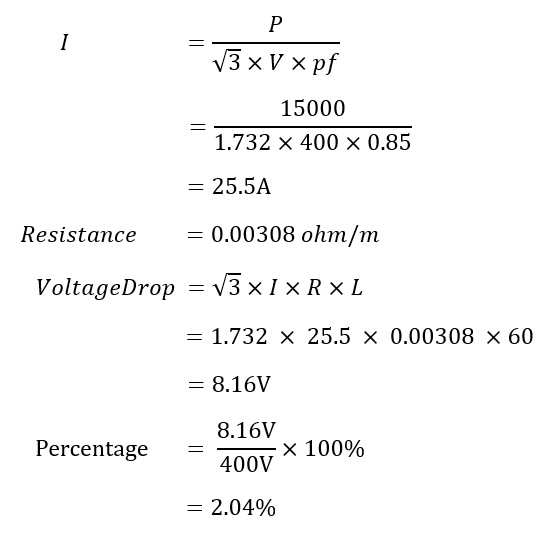
✔ Result:
Suitable for industrial wiring (limit 5%).
Tips for Reducing Voltage Drop
Voltage drop can be reduced in simple and practical ways. The most effective method is using a thicker cable. Thicker cables have lower resistance and lose less voltage.
Keeping cable runs as short as possible also helps. Avoid unnecessary looping or long routes. Using copper instead of aluminum improves performance.
Another helpful practice is separating heavy loads into dedicated circuits. This reduces current on each cable and improves voltage levels.
Conclusion
Voltage drop calculation is essential for designing safe and efficient electrical installations. By using the formula and tables provided in this guide, you can easily:
✔ Select the correct cable size
✔ Ensure your installation meets both household and industrial standards
Whether you’re an electrician, engineer, or student, understanding this concept will help you build better and safer electrical systems.