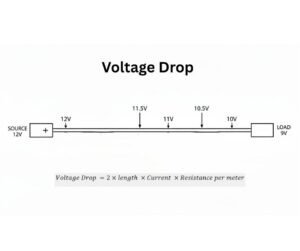


Choosing the correct cable size is one of the most important steps in house wiring. Many homeowners and beginners think wiring is simple once switches and sockets are placed. But the real safety of a house depends on the cables hidden inside the walls. The wrong cable size can create problems that are not visible at first.
One common mistake is choosing a cable based on guesswork or copying another house. Some people use the smallest cable to save money. Others choose very thick cables, thinking bigger is always safer. Both approaches can cause problems if calculations are ignored.
The idea that “bigger is safer” is not always true. Very large cables are harder to install and may not fit properly into terminals. They also increase cost without real benefit if the load is small. The correct cable size is the one that safely carries the expected current with proper margins.
Undersized cables are far more dangerous. They heat up when too much current flows through them. Over time, this heat damages insulation and increases fire risk. Long cable runs with small sizes also cause voltage drop, which can damage appliances.
By the end of this guide, you will understand how to select cable sizes step by step. You will learn how to calculate current, apply safety factors, and choose standard cable sizes. Most importantly, you will gain confidence to make safe wiring decisions.
Table of Contents
Basic Electrical Concepts You Must Know
You do not need deep theory to select cable sizes. You only need a few basic ideas explained simply. Let us go through them one by one.
Voltage (V)
Voltage is the electrical pressure that pushes current through a cable. Most houses around the world use either 110V or 230V. Countries like the USA use around 110V, while many others use 230V. Cable size depends more on current than voltage, but voltage is still needed for calculation.
Current (I)
Current is the flow of electricity through a cable. This is the most important factor for cable sizing. When the current increases, the cable heats up. If the cable is too small, the heat becomes dangerous.
Power (W)
Power tells us how much energy an appliance uses. Power depends on both voltage and current. The simple relationship is that power equals voltage multiplied by current. We use this relationship to calculate the current from the appliance power.

Single-Phase vs Three-Phase Supply
Most houses use a single-phase supply. It is enough for lighting, sockets, and normal appliances. Three-phase supply is used in larger houses or homes with heavy loads. Cable sizing logic is similar, but the current calculation is slightly different.
What Determines Cable Size in House Wiring?
Cable size is not chosen randomly. Several practical factors decide it. The most important one is load current, which comes from connected appliances. Lighting circuits need less current than air conditioners or water heaters.
The type of load also matters. Continuous heavy loads produce more heat than small or short-term loads. Cable length plays a role because longer cables cause more voltage drop. If the voltage drop is too high, appliances may not work properly.
Step-by-Step Cable Size Calculation Method
This section is the heart of the guide. Follow these steps carefully, and cable selection becomes simple.
Step 1: Identify the Connected Load
First, list all appliances connected to the circuit. For example, lights, fans, sockets, or a specific appliance. Each appliance has a power rating in watts, usually written on it. This value tells us how much power it consumes.
Example -: Imagine you’re planning a kitchen circuit for three countertop appliances that might run simultaneously. The cable runs from your electrical panel to the kitchen outlets.
Step 2: Calculate the Total Load Power
Add the power of all connected appliances. The total power is the sum of all these values. This total power is what the cable must handle.
Appliances (All 230V, Single-Phase):
1.Toaster: 800W
2.Microwave Oven: 900W
3.Electric Kettle: 2000W
Step 3: Calculate the Load Current
Now calculate current using a simple formula.
Current equals power divided by voltage.
For a 230V single-phase supply, divide total power by 230. The result is current in amperes. This tells you how much current flows through the cable during normal operation.
- Microwave: 900W ÷ 230V = 3.91 A
- Kettle: 2000W ÷ 230V = 8.70A
- Toaster: 800W ÷ 230V = 3.48 A
Total possible current if all run together: 3.91 + 8.70 + 3.48 = 16.09 A
Step 4: Apply Safety Factor
Never choose a cable exactly equal to calculated current. Real conditions are not perfect. Temperature changes, Manufacturing tolerances, Cable aging and future load additions increase stress. A safety margin of about 20 to 25 percent is commonly used. This keeps the system reliable and safe.
With 20% Safety Factor Applied:
Design Current with margin = 16.09A × 1.20 = 19.3A
Same result: 20A for practical purposes
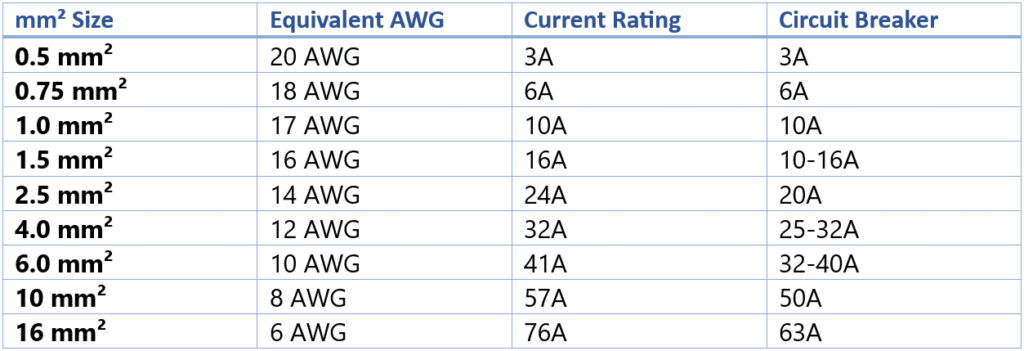
Step 5: Select the Nearest Standard Cable Size
Cables are made in standard sizes like 1.5 mm² or 2.5 mm². You will not find a cable that matches your calculation exactly. Always choose the next higher standard size. This ensures the cable operates comfortably.
Voltage Drop Consideration
Voltage drop is the loss of voltage along the length of a cable. It happens because cables have resistance. In short cable runs, voltage drop is small and often ignored. But in long runs, it becomes important.
For houses, voltage drop is usually limited to a small percentage. When voltage drop is high, lights become dim and motors overheat. Increasing cable size reduces voltage drop. This is why long-distance circuits often need thicker cables.

First, calculate the maximum allowed voltage drop. The maximum allowed voltage drop can vary between 3% – 5% according to standards. Let’s assume the maximum allowed voltage drop is 5%. Then,
Allowable voltage drop
= 5% of 230 V
= 0.05 × 230
= 11.5 V0
Voltage Drop
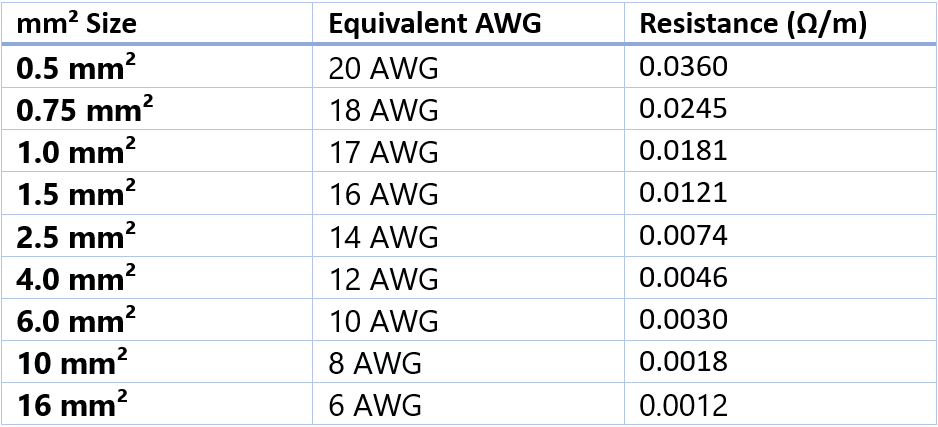
= 2 × 20 m × 20 A × 0.0074 Ω
=5.92V
Think what if it goes beyond the maximum allowed voltage drop range. You should select the next higher size of cable. You can see that higher size cables have lower Resistance per meter values.
Standard Cable Sizes Used in House Wiring
Very small cables like 1.0 mm² are used only for low-current control wiring. They are not suitable for power circuits. The 1.5 mm² cable is commonly used for lighting because lights draw small current.
The 2.5 mm² cable is widely used for socket outlets. It can handle moderate loads safely. The 4.0 mm² cable is used for heavier appliances like water heaters. Cables of 6.0 mm² and above are used for air conditioners, cookers, and sub-main connections. These sizes are chosen because they balance current capacity, heat, and voltage drop.
More Examples
Examples make understanding much easier. Let us look at simple real-world cases.
1.For a lighting circuit, suppose the total load is 400W at 230V. The current is less than 2A. After applying safety margin, a 1.5 mm² cable is sufficient.
2.For socket outlets, loads are mixed and unpredictable. Even if average load is low, sudden high usage is possible. That is why 2.5 mm² is commonly selected with proper circuit protection.
3.For an air conditioner or water heater, current is high and continuous. Even small mistakes here cause serious heating. Using the correct cable size with margin is critical for safety and long-term reliability.
Common Mistakes to Avoid
Many people choose smaller cables to reduce cost. This saves money only at installation time. Later repairs and risks cost much more. Ignoring voltage drop is another common mistake, especially in large houses.
Copying wiring from another house without calculation is dangerous. Mixing aluminum and copper assumptions also causes errors. Not planning for future load expansion often leads to rewiring later.
Why This Matters for Homeowners
- Safety First: Undersized cables overheat, causing fire risks
- Performance: Proper sizing prevents voltage drop (dim lights, slow appliances)
- Compliance: Meets building regulations for insurance and resale
- Future-proofing: Allows for adding more appliances later
Cable Size Selection According to Standards
Most countries follow IEC or BS standards. The USA and Canada follow NEC. Even though tables differ slightly, the calculation logic remains the same. Current, safety margin, and voltage drop always guide cable selection.
Safety Tips from a Professional Electrical Engineer
Proper earthing is as important as correct cable size. Always match cable size with correct MCB ratings. Use good quality cables with certified insulation. If you feel unsure at any stage, consult a licensed electrician.
Making Safe and Smart Wiring Decisions
Cable size selection is not about guessing or copying others. It is about understanding load, current, and safety. Simple calculations can prevent serious problems. When you choose the right cable size, you protect your home and appliances.
Always prioritize safety over cost. Proper wiring lasts for decades and gives peace of mind. A few minutes of calculation can prevent years of trouble.ystematic method:
- Calculate the load current
- Apply safety factors
- Compare with cable current rating charts
- Check voltage drop
- Choose the safest cable size
Following these steps ensures a safe, efficient, and durable electrical installation for any home.
FAQ
Avoid mixing sizes in the main run. You may use a smaller cable only for a short, protected spur to a specific appliance, ensuring it is still safeguarded by the circuit breaker.
Yes, this usually indicates excessive voltage drop, often due to undersized cable or lighting and sockets sharing a circuit. Consider separate circuits or upgrading the cable.
The cable can overheat and cause a fire before the breaker trips. Always ensure the cable’s current rating is equal to or greater than the breaker’s rating.
No. A 13A fuse doesn’t prevent excessive voltage drop or guarantee short-circuit protection. For safety, match the cable to the load and installation conditions.
mV/A/m (millivolts per amp per meter) is used to calculate voltage drop. Multiply it by the current and length, then divide by 1000 to find the voltage drop in volts.
1.0–1.5 mm² is sufficient due to LEDs’ low power. However, 1.0 mm² is often the practical minimum for mechanical strength and future-proofing.
Thicker cables are safer but cost more, are harder to install, and may not fit in conduits or terminals. Oversizing can also cause circuit protection issues if the breaker is too small.
For power sockets, the minimum is 2.5 mm², typically protected by a 20A or 32A circuit breaker. Lighting circuits can use 1.0–1.5 mm².
Slight warmth is normal. If it’s too hot to touch (>50°C), discoloured, or smells, it may be overloaded. Check the load and cable size immediately.
Longer cables have higher resistance, which can reduce fault current and delay breaker tripping. Check that fault levels are sufficient for the chosen breaker type.
To see more depth about cable size calculation,